LED Makeup Cases: Specify the Handle Attachment
What should buyers request for an LED makeup case handle? Ask the supplier to identify the offered handle, its attachment locations and component specification, then provide the intended complete-case handling guidance and a proposed sample demonstration. Keep any declared carrying limit linked to the actual case version and supporting evidence. A catalogue handle photograph does not establish a load rating or reveal the hidden attachment construction.
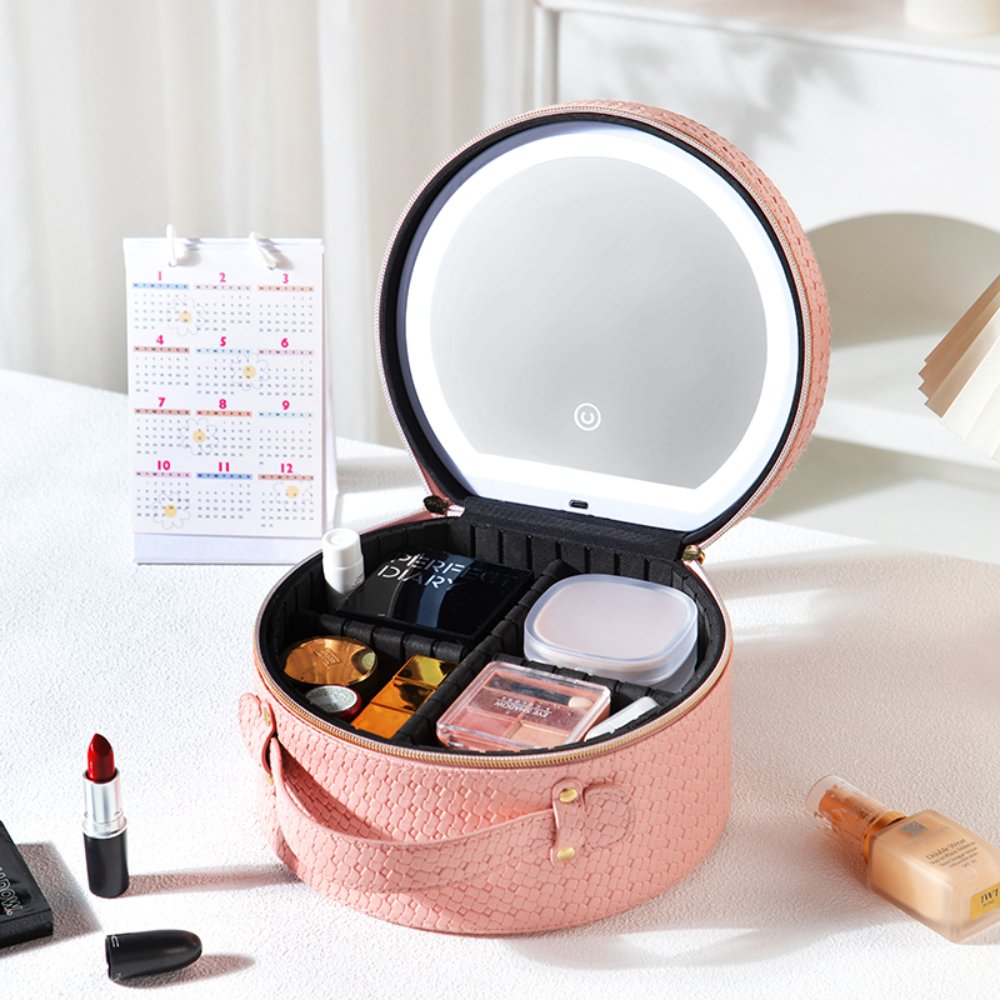
Official round-case reference. Ask the supplier to identify the handle and attachment assembly; the scene does not establish a load rating, hidden reinforcement or supplied cosmetics.
Identify the handle on the actual case model
Haofeng lists an LED Lit Makeup Case and shows a round pink case in its official gallery. The outer handle arrangement can be seen in the open and closed references. Use that product link and the supplier’s offered model reference to begin a handle enquiry, rather than applying assumptions from another makeup bag.
A buyer sourcing wholesale LED makeup cases may need to confirm how the complete case is intended to be picked up and carried. That question is separate from whether the mirror lights up, which cosmetics fit inside or how the retail set is presented. Identify the case version and the handle configuration being quoted before asking for further details.
The reviewed visible text does not provide a handle construction schedule or a carrying-load declaration. The photographs identify an area for discussion; they do not supply an undisclosed specification. Keep the supplier’s response tied to the selected case instead of borrowing figures from the separately listed mini LED makeup bag.
Buying field
Requested supplier response
Case and handle identity
Offered round-case model, variant and supplier reference for the handle assembly.
Attachment map
Labelled locations where the handle joins the case and the scope of each part.
Component specification
Supplier-declared materials and construction references for the offered assembly.
Intended handling
How the complete case should be closed, supported, lifted and carried.
Sample demonstration
Supplier-proposed conditions, identified sample and observations to record.
Approval and changes
Accepted version and evidence, with substitutions or attachment changes confirmed separately.
Request an attachment map without inferring hidden parts
Ask for a labelled view that identifies the handle and the places where it joins the body. The supplier can explain which visible pieces belong to that assembly and which are decorative or serve another purpose. This prevents an appearance detail from being treated as an agreed structural specification.
Where attachment construction matters to the purchase, request the supplier’s available drawing, component description or other reference. Ask what it shows and what remains outside its scope. Do not assume a particular reinforcement, stitch arrangement, fastener material or internal backing simply because the outside has a familiar appearance.
A material description should identify the relevant component. A general case-cover description does not necessarily specify the handle, its attachment tabs or any hidden parts. Ask the supplier to state the offered scope clearly, and identify proposed alternatives separately rather than treating every visually similar version as equivalent.
The outer handle region can be located in this catalogue view. Confirm the offered component and construction specification rather than inferring material or strength from its appearance.
Clarify the intended complete-case handling guidance
Request the supplier’s instructions for the selected assembled case. The guidance should explain the intended handling configuration and any preparation the supplier requires before lifting. Ask which closures or supports are involved, without inventing instructions from an open display scene.
If the supplier declares a carrying limit, ask what the stated quantity includes and which case version it covers. Confirm the supporting method or evidence and its limits before copying the declaration into a purchase specification or sales description. This guide supplies no load value and makes no strength claim for the listed case.
Cosmetics, bottles and other catalogue props are not a defined carrying-test load or a confirmed supplied bundle. A buyer can describe its intended use and ask the supplier how to evaluate that configuration. Keep the answer linked to the offered case, its handle assembly and the agreed scope of the review.
Agree a sample demonstration and observation record
Ask the supplier to propose a demonstration appropriate to the purchasing question. Identify the sample, its starting condition, the intended contents or agreed reference load, and the handling sequence. The parties should decide the method and decision criteria before treating an observation as approval.
Record what was actually done and observed. A useful record can identify the gripping position, case configuration and the attachment areas reviewed before and after the agreed handling. Describe visible movement, a changed appearance or another observation without assigning an unprovided cause. No such defect is alleged for the catalogue product.
An unlabelled lifting photograph is not a complete evidence package. Ask how its conditions relate to the offered production version and whether additional information is needed for the buyer’s requirement. Do not expand one demonstration into a general durability, repeated-use or transport claim.
Official open/closed references help identify the proposed handling configuration. They do not document a carrying test or establish an approved complete-case load.
Approve the assembly within a defined purchasing scope
Keep the handle decision separate from mirror mounting and electrical configuration. A successful lighting demonstration does not establish attachment performance, while approval of a handle sample does not settle battery, mirror or retail-set questions. Each record should identify the same offered case where relevant.
Retain the attachment map, component references, handling guidance and agreed sample record with the decision. State what was accepted and what remains unconfirmed. Ask the supplier to identify proposed changes to handle material, attachment construction or location before treating the revised assembly as the approved version.
For receiving and order handover, provide references that staff can recognise. They should know which case and handle version were reviewed, what visible features were identified and which differences need clarification. This communication record does not create a test standard, acceptance limit or guaranteed service life that the parties have not agreed.
Buyer FAQ
Can a catalogue handle image establish a load rating?
No. It identifies the visible configuration. Request the supplier’s declaration for the actual case and its supporting evidence and scope.
Does the outer case material define every handle component?
Not necessarily. Ask for component-specific material and construction information for the offered handle and attachment assembly.
Are the displayed cosmetics a verified test load?
No. They are catalogue props unless the supplier separately identifies them as part of a documented sample demonstration.
Can figures from the mini makeup bag be used for this case?
No. The separately listed mini bag is a different product reference. Obtain the relevant information for the actual round case.
What should a handle approval retain?
Keep the case version, attachment map, supplier component references, intended handling guidance, sample evidence and written decision scope together.
Start with the actual LED Lit Makeup Case reference. Send Haofeng the handle and attachment enquiry and ask for its proposed evidence. See the organizer blog for related purchasing topics.
Identify the offered case and handle attachment assembly.
Request component references and intended handling guidance.
Approve defined sample evidence and confirm proposed changes.
wholesale lit makeup bag / lit makeup casesB2B supplier sample record